Learning English can be fun!

Learning English will provide you with new opportunities for work, entertainment, social life, travel, etc.

Sunday, 27 November 2011

Stradivarius

The article I’ve chosen is about Stradivarius violins. Many people know that these instruments are famous, but why?
They were made (about 1200 pieces) between 17th and 18th century by Antonio Stradivari, and they’re well-known by their great sound. Many manufacturers have investigated the sound, but they haven’t been able to explain exactly why Stradivarius violins sound so beautifulyl. It’s believed it could be the wood or the glue.
At present, only about 500 Stradivarius violins have been found, and they belong to famous violinists or Museums. In Spain, there are two pieces in the Agency of National States.
The last time one of these instruments was sold was in October 2010, to a Japanese woman, by 3.000.000 $.
Talking about their value and economic cost, in October 2010 was the last time one of these instruments was sold for 3.600.000 $ (nearly 2.600.000 euros). But if you think you’ve found one of these, find evidence of it, because there are a lot of copies in the world.

MARÍA PAREJA

Monday, 21 November 2011

Spain election victor Rajoy warns 'no miracles'

Conservatives in Spain are celebrating a landslide victory

Related Stories

Spain's Popular Party leader Mariano Rajoy has told supporters their country's voice must be respected again, after a resounding election win.
At the end of a campaign dominated by the debt crisis, the centre right PP secured 186 seats in the 350-seat lower house of parliament.
However, Spain's borrowing costs continued to mount on Monday and the stock market fell by 2%.
Mr Rajoy said: "There won't be any miracles. We never promised any."
Speaking outside party headquarters in central Madrid, he assured his audience: "We will stop being part of the problem and will be part of the solution."

Continue Reading: BBC..co.uk

Tuesday, 11 October 2011

Amazing podcast about economics today


Making Rich People Richer Doesn't Make the Rest of Us richer' and 22 other Things They Don't Tell You About Capitalism

Listen to this podcast from The London School of Economics, and you'll understand a lot more about the world in which we are living today.


Write a comment!


Sunday, 2 October 2011

Improve your reading ability

If you do not have skill and confidence in reading, if you do badly at reading comprehension texts, try to make the best of these materials by the British authorities. They are designed for school grades (7-12), but they can be of great use.

Wednesday, 28 September 2011

Labour Conference Speech

Watch this video about the leader of the Labour Party. 


What are the main ideas of Ed Miliband's speech?


Take notes.


Read The Telegraph and the BBC!


Participate in discussions with classmates.

Saturday, 24 September 2011

Welcome

Hello, students!

This year we are going to be together for 120 hours! So let's have a great time from the start.

In order to get to know you and adjust my lessons to your abilities and interests let's complete this questionnaire.


The materials for this year will be those provided by Pearson-Longman: Speakout Upper-Intermediate Students' book with Active book and DVD.
Those with lots of extratime for homework can also get the Speakout Upper-Intermediate Workbook with key and Audio CD for self-study purposes.

Wednesday, 29 September 2010

Biography


A WebQuest for NA1
EOI Valencia
Designed by Inma Garín


Q. What is A WebQuest?
A. A WebQuest is an inquiry-oriented lesson format in which most or all the information that learners work with comes from the web.


Introduction:


Why a biography? By learning about other people’s lives, we undoubtedly learn about ourselves. This genre not only provides a portrait of the person being presented, but also gives insight into the society, culture, and specially the context in which the person lived.
A good biography should display the person’s personality and help us understand his/her achievements and reasons for his/her actions.


Task:


You will write a biography of somebody you admire. In order to do that
You are going to work with a partner. First, you are going to discuss with him/her and decide on the person you want to write about. Give reasons and reach a joined decision. Before the discussion, visit: http://www.biographyshelf.com/
On the right hand side of the page there is a list of characters you can choose from. Once you have all the information you need, you’ll design a power point to present to the whole group.
Secondly, and on your own, you are going to write a text mentioning the different stages in the life of that person with the relevant people and places at each stage and write your own biography (200-250 words in 4/5 paragraphs), using your own words.


Process:


You’ll have four lessons. The first will be to search for information. The second to create the power point, the third to write your text and the fourth to present your work.
The first two sessions will take place in the computer room and the other two in our classroom.
If you don’t understand a word, go to one of these:
http://dictionaries.cambridge.org/?dict=CLD2
http://oxforddictionaries.com/?attempted=true
http://www.merriam-webster.com/home.htm
http://www.wordreference.com/es/
Other pages you can go to:
http://www.cmgww.com/historic/wilde/
http://www.online-literature.com/conrad/
http://www.mcsr.olemiss.edu/~egjbp/faulkner/faulkner.html
http://www.historyguide.org/intellect/wollstonecraft.html


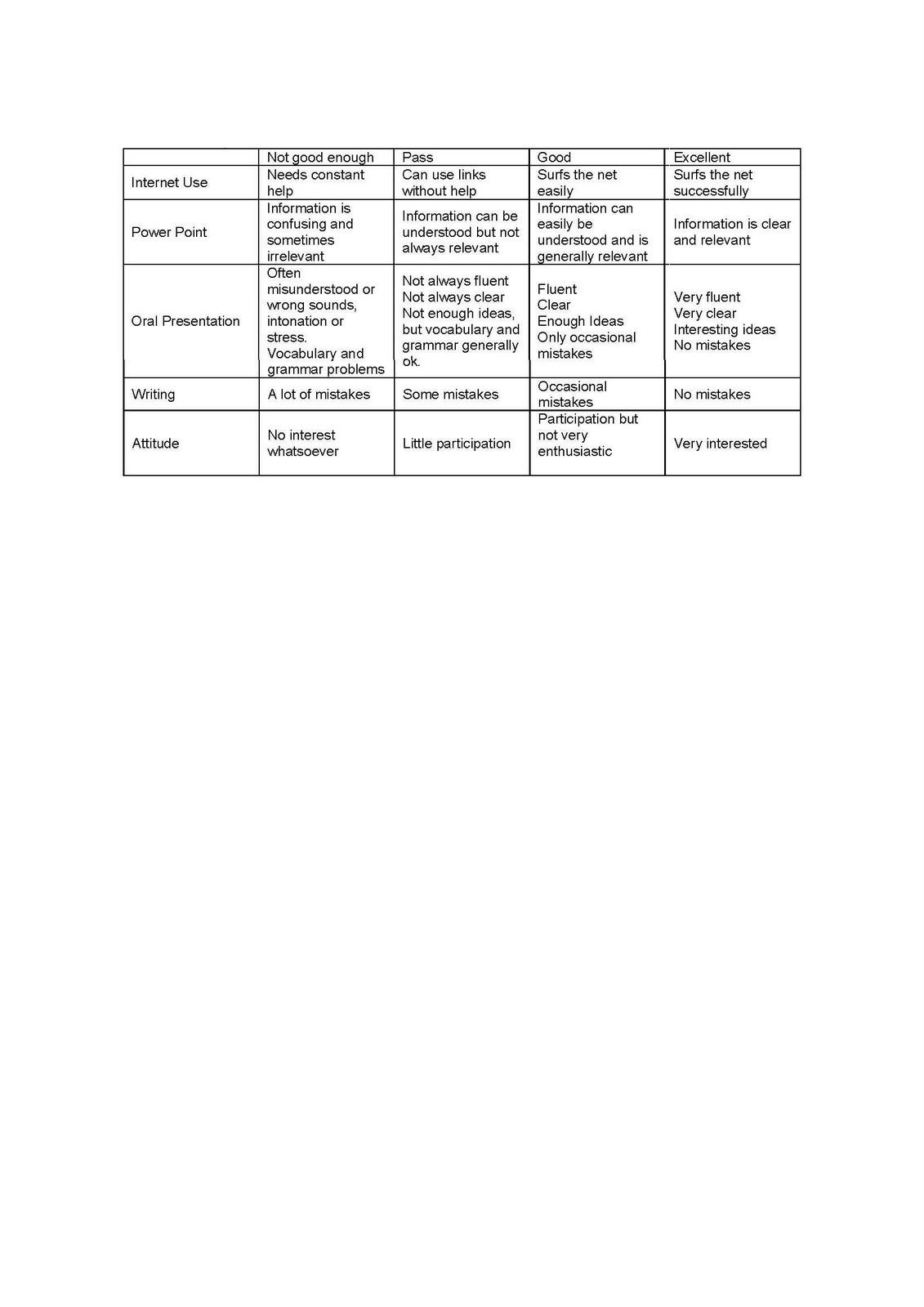
Assessment:


Marks:

Fail Pass Good Excellent

Conclusion:

Congratulations! If you are here now, it means that you have successfully completed the task, you can surf the net in search of information about a person, can select the most important facts and can talk about him/her in front of an audience. You realize that it is not so difficult to use the ICTs to boost your learning. You can even enjoy doing it with a partner and people around to help you. Learning English can be funny!

Didactic Guide:

• Area: English (FLT)
• Level: EOI NA1 (B2-)
• Objectives:
- Using dictionaries on line
- Understanding written texts
- Using info from Web to build a text
- Writing a biography using paragraphs, the verb system, connectors and appropriate vocabulary for an intended audience
• Contents:
- Reading Comprehension (scanning and skimming)
- Writing narrative texts (organization, paragraphing, spelling, etc.)
• Segmentation:
-140 minutes lesson: searching for info
-140 minutes lesson: designing presentation
- 140 minutes lesson: writing & revision
- 140 minutes lesson: Oral presentation

• Resources:
-computer
-Mozilla or other surfer
-Internet connection
-Word Processor
-Ppt application