Learning English can be fun!

Learning English will provide you with new opportunities for work, entertainment, social life, travel, etc.
Showing posts with label reading. Show all posts

Tuesday, 21 February 2012

International Women's Day

We are preparing a poetry reading of Emily Dickinson's work for March 8th, The International Women's Day. Known because of her introverted and reclusive life, Dickinson managed to write intensively until after her death, when Dickinson's family discovered 40 handbound volumes of nearly 1800 of her poems, or "fascicles" as they are sometimes called which had been kept in her room unnoticed.

 Admired throughout the world now and studied in most universities, ED  vas inspired by the poetry of Robert and Elizabeth Barrett Browning, as well as John Keats.

Dissuaded from reading the verse of her contemporary Walt Whitman by rumor of its disgracefulness, the two poets are now connected by the distinguished place they hold as the founders of a uniquely American poetic voice.

Although fewer than a dozen of her nearly eighteen hundred poems were published during her lifetime, Dickinson's poems are unique for the era in which she wrote; they contain short lines, typically lack titles, and often use slant rhyme as well as unconventional capitalization and punctuation. Many of her poems deal with themes of death and immortality, two recurring topics in letters to her friends.

If you want to train for the poetry reading, come to our conversation class Tuesdays and Thursdays at 12.00 room 2.3: sounds, intonation, tone units, linking devices, pauses, etc.

If you cannot attend, but are curious about this poet, go to:


Friday, 10 February 2012

Wednesday, 29 September 2010

Biography


A WebQuest for NA1
EOI Valencia
Designed by Inma Garín


Q. What is A WebQuest?
A. A WebQuest is an inquiry-oriented lesson format in which most or all the information that learners work with comes from the web.


Introduction:


Why a biography? By learning about other people’s lives, we undoubtedly learn about ourselves. This genre not only provides a portrait of the person being presented, but also gives insight into the society, culture, and specially the context in which the person lived.
A good biography should display the person’s personality and help us understand his/her achievements and reasons for his/her actions.


Task:


You will write a biography of somebody you admire. In order to do that
You are going to work with a partner. First, you are going to discuss with him/her and decide on the person you want to write about. Give reasons and reach a joined decision. Before the discussion, visit: http://www.biographyshelf.com/
On the right hand side of the page there is a list of characters you can choose from. Once you have all the information you need, you’ll design a power point to present to the whole group.
Secondly, and on your own, you are going to write a text mentioning the different stages in the life of that person with the relevant people and places at each stage and write your own biography (200-250 words in 4/5 paragraphs), using your own words.


Process:


You’ll have four lessons. The first will be to search for information. The second to create the power point, the third to write your text and the fourth to present your work.
The first two sessions will take place in the computer room and the other two in our classroom.
If you don’t understand a word, go to one of these:
http://dictionaries.cambridge.org/?dict=CLD2
http://oxforddictionaries.com/?attempted=true
http://www.merriam-webster.com/home.htm
http://www.wordreference.com/es/
Other pages you can go to:
http://www.cmgww.com/historic/wilde/
http://www.online-literature.com/conrad/
http://www.mcsr.olemiss.edu/~egjbp/faulkner/faulkner.html
http://www.historyguide.org/intellect/wollstonecraft.html


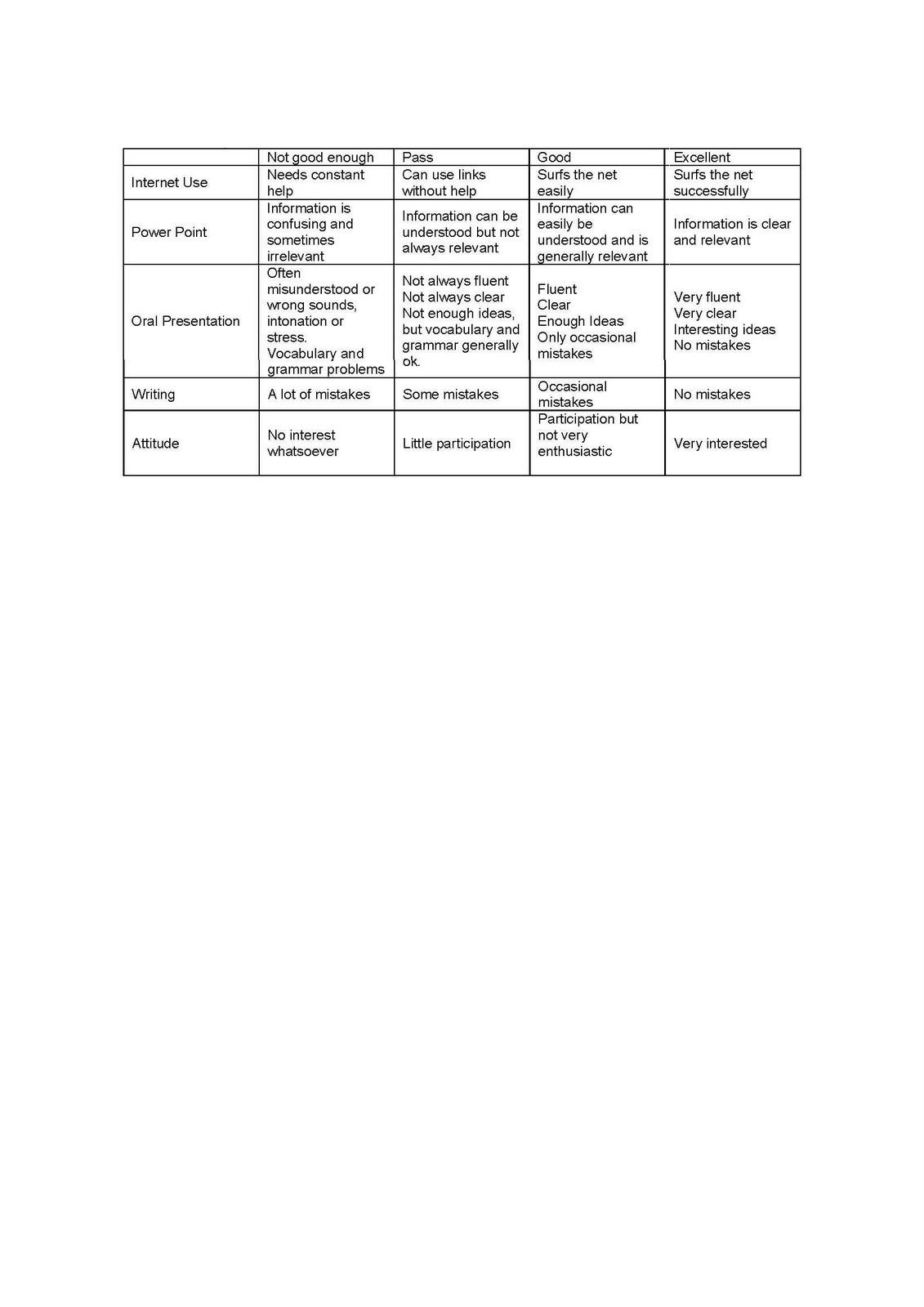
Assessment:


Marks:

Fail Pass Good Excellent

Conclusion:

Congratulations! If you are here now, it means that you have successfully completed the task, you can surf the net in search of information about a person, can select the most important facts and can talk about him/her in front of an audience. You realize that it is not so difficult to use the ICTs to boost your learning. You can even enjoy doing it with a partner and people around to help you. Learning English can be funny!

Didactic Guide:

• Area: English (FLT)
• Level: EOI NA1 (B2-)
• Objectives:
- Using dictionaries on line
- Understanding written texts
- Using info from Web to build a text
- Writing a biography using paragraphs, the verb system, connectors and appropriate vocabulary for an intended audience
• Contents:
- Reading Comprehension (scanning and skimming)
- Writing narrative texts (organization, paragraphing, spelling, etc.)
• Segmentation:
-140 minutes lesson: searching for info
-140 minutes lesson: designing presentation
- 140 minutes lesson: writing & revision
- 140 minutes lesson: Oral presentation

• Resources:
-computer
-Mozilla or other surfer
-Internet connection
-Word Processor
-Ppt application

Saturday, 2 January 2010

January 2010 First Book Club


Did you survive Christmas? Well, if you are still in one piece, let's see how to approach the incoming month.

First of all The Book Club, which will take place as soon as we are back from holidays. As you all know the title is Address Unknown by Kressman Taylor.

Have you found out anything about the writer? Well, if you haven't, go into the wikipedia (English) and read and take notes to show how much you know.

Then if you have read it a long time ago, go through it again and take notes of what happens at each stage of the book. Who are the main characters? What are they like? Is there any development of the main characters?

What secondary characters are there? What role do they play in the story as a whole?

Is there a passage you would like to comment? Which one? What are the best ideas in the book?

What is the plot about? How does it develop? What sections or aspects were more shocking?

Is there a pattern or style? Which is it? What kind of writing is it?

Why was the book written? What is the context?

What effect did the book have on you? How did you respond to it?

Use these reflexions for the book club.

Was the language difficult? Are there any expressions you wrote down? Which ones?

What is the main theme? Did you learn anything from the writer's approach to the material?

Use these thoughts to lead you through a second reading and comments in class.


Tuesday, 2 December 2008

Reading Strategies


Uploaded on authorSTREAM by migmartinez