
Sunday, 2 October 2011
Improve your reading ability
If you do not have skill and confidence in reading, if you do badly at reading comprehension texts, try to make the best of these materials by the British authorities. They are designed for school grades (7-12), but they can be of great use.

Wednesday, 28 September 2011
Labour Conference Speech
Watch this video about the leader of the Labour Party.
What are the main ideas of Ed Miliband's speech?
Take notes.
Read The Telegraph and the BBC!
Participate in discussions with classmates.
What are the main ideas of Ed Miliband's speech?
Take notes.
Read The Telegraph and the BBC!
Participate in discussions with classmates.
Saturday, 24 September 2011
Welcome

This year we are going to be together for 120 hours! So let's have a great time from the start.
In order to get to know you and adjust my lessons to your abilities and interests let's complete this questionnaire.
The materials for this year will be those provided by Pearson-Longman: Speakout Upper-Intermediate Students' book with Active book and DVD.
Those with lots of extratime for homework can also get the Speakout Upper-Intermediate Workbook with key and Audio CD for self-study purposes.
Wednesday, 29 September 2010
Biography

A WebQuest for NA1
EOI Valencia
Designed by Inma Garín
Q. What is A WebQuest?
A. A WebQuest is an inquiry-oriented lesson format in which most or all the information that learners work with comes from the web.
Introduction:
Why a biography? By learning about other people’s lives, we undoubtedly learn about ourselves. This genre not only provides a portrait of the person being presented, but also gives insight into the society, culture, and specially the context in which the person lived.
A good biography should display the person’s personality and help us understand his/her achievements and reasons for his/her actions.
Task:
You will write a biography of somebody you admire. In order to do that
You are going to work with a partner. First, you are going to discuss with him/her and decide on the person you want to write about. Give reasons and reach a joined decision. Before the discussion, visit: http://www.biographyshelf.com/
On the right hand side of the page there is a list of characters you can choose from. Once you have all the information you need, you’ll design a power point to present to the whole group.
Secondly, and on your own, you are going to write a text mentioning the different stages in the life of that person with the relevant people and places at each stage and write your own biography (200-250 words in 4/5 paragraphs), using your own words.
Process:
You’ll have four lessons. The first will be to search for information. The second to create the power point, the third to write your text and the fourth to present your work.
The first two sessions will take place in the computer room and the other two in our classroom.
If you don’t understand a word, go to one of these:
http://dictionaries.cambridge.org/?dict=CLD2
http://oxforddictionaries.com/?attempted=true
http://www.merriam-webster.com/home.htm
http://www.wordreference.com/es/
Other pages you can go to:
http://www.cmgww.com/historic/wilde/
http://www.online-literature.com/conrad/
http://www.mcsr.olemiss.edu/~egjbp/faulkner/faulkner.html
http://www.historyguide.org/intellect/wollstonecraft.html
Assessment:
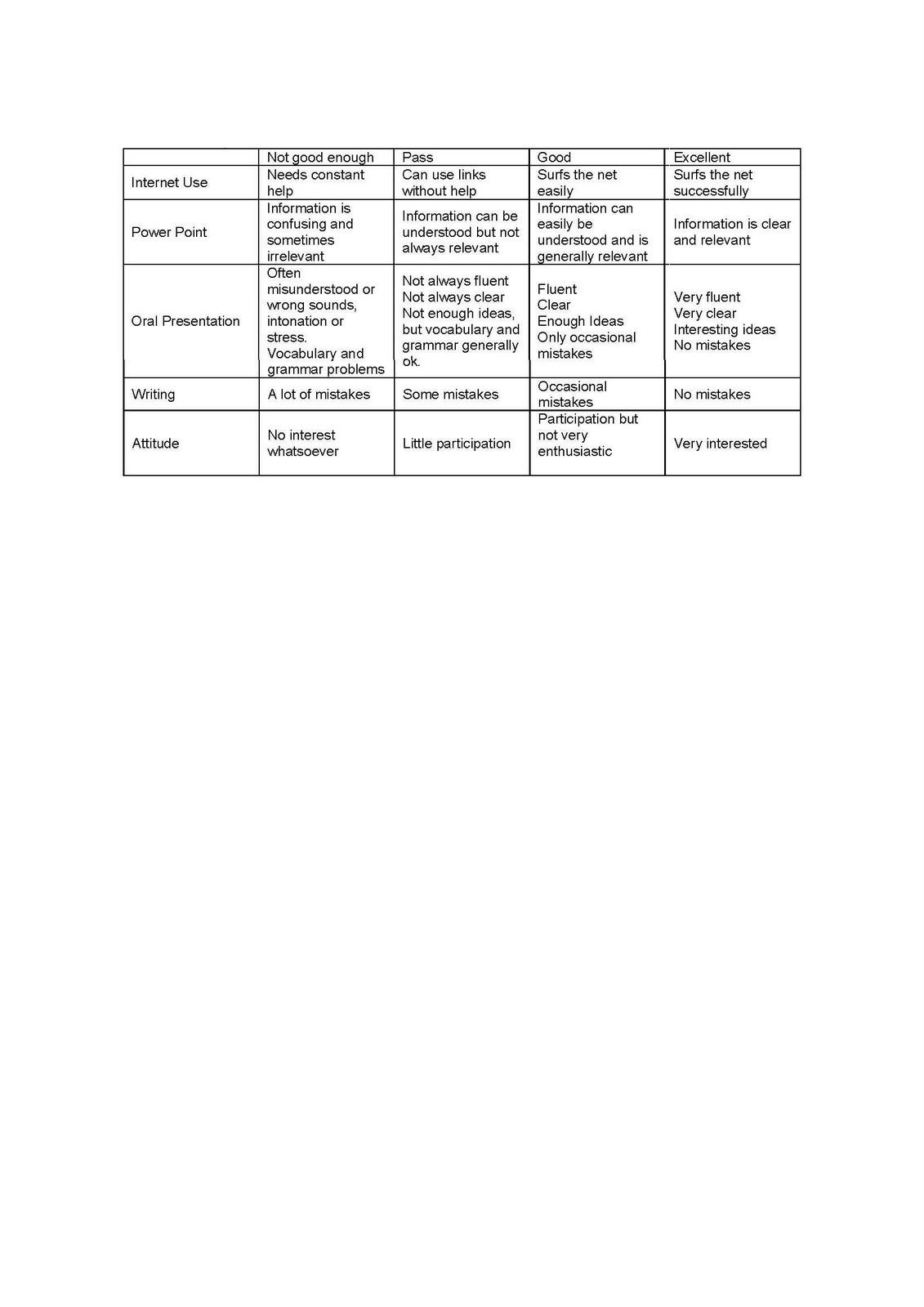
Marks:
Fail Pass Good Excellent
Conclusion:
Congratulations! If you are here now, it means that you have successfully completed the task, you can surf the net in search of information about a person, can select the most important facts and can talk about him/her in front of an audience. You realize that it is not so difficult to use the ICTs to boost your learning. You can even enjoy doing it with a partner and people around to help you. Learning English can be funny!
Didactic Guide:
• Area: English (FLT)
• Level: EOI NA1 (B2-)
• Objectives:
- Using dictionaries on line
- Understanding written texts
- Using info from Web to build a text
- Writing a biography using paragraphs, the verb system, connectors and appropriate vocabulary for an intended audience
• Contents:
- Reading Comprehension (scanning and skimming)
- Writing narrative texts (organization, paragraphing, spelling, etc.)
• Segmentation:
-140 minutes lesson: searching for info
-140 minutes lesson: designing presentation
- 140 minutes lesson: writing & revision
- 140 minutes lesson: Oral presentation
• Resources:
-computer
-Mozilla or other surfer
-Internet connection
-Word Processor
-Ppt application
Saturday, 8 May 2010
UK Elections

Recent elections in the UK have ended with a hung parliament, so the country is uncertain about its future outcome.
The Observer editorial on Sunday 1st of May encouraged its readers to vote for him. This editorial is worth quoting whole as an excellent analysis of British politics and a brilliant piece of political journalism.
"The rotten parliament is dissolved; this week a new one will be elected. Scores of incumbents who fiddled their expenses will be evicted. Many who did not are standing down anyway, too defeated by the public's loathing of politicians to face the campaign trail.
So change is inevitable. Parliament will be full of novice MPs. It might also, if current opinion polls are borne out, be hung.
The Conservatives have spent much energy campaigning against that outcome. They have publicised their irritation that voters could deprive David Cameron of a majority much better than they have explained why he deserves one in the first place.
Mr Cameron warns portentously that a coalition might lead to instability, economic jeopardy and "more of the old politics". Perversely, he also rejects the need to change the current voting system, which has, he says, the merit of delivering clear results. Except this time it might not. What then? Mr Cameron's view is that the system would work fine, if only everyone voted Conservative. This is sophistry draped in hypocrisy. He backs first past the post, while agitating against one of the outcomes that is hard-wired into it. He is campaigning against the voters instead of pitching for their support. He defines change in politics as the old system preserved – but run by the Tories.
The expenses scandal signalled the need for more radical reform. This newspaper has consistently argued that the most effective change would be to introduce a fairer voting system. The current model contains a huge bias towards Labour and the Conservatives, giving them hundreds of safe seats where MPs can complacently ignore voters. Parties then divert money and skew policy towards a handful of tactically important constituencies. Awarding seats in parliament in proportion to votes cast would extend the franchise to millions of people who feel their voices have gone unheard. Deep unfairness radiates out of our voting system and corrupts our politics. This can only be fixed with electoral reform.
If a different system yields more coalition governments, so be it. Mr Cameron ought to appreciate how like coalitions the current political parties already are. Conservative policy expresses the party's agonies in recent years as different factions have competed to graft their priorities on to the leader's mutating creed.
When Mr Cameron became leader in 2005 he recognised that the party was widely perceived as uncaring and ill-disposed towards 21st-century Britain. He embarked on a campaign of modernisation. He tried to stamp out illiberal views on homosexuality. He sought to promote candidates from minority communities. He shifted rhetoric away from attacks on immigration and the European Union, professing instead enthusiasm for the environment and international aid. That process yielded a rise in opinion poll ratings, but provoked suspicion within the party.
In some policy areas, the Conservative party has genuinely changed. The Tories are reconciled to the minimum wage, civil partnerships, the NHS. But the project is incomplete.
Modern Conservatives, Mr Cameron says, are open. But the Tories concealed for years the non-domicile tax status of Lord Ashcroft, their deputy chairman and campaign financier. Modern Conservatives are supposed to accept gay rights. But the party is allied in the European parliament with homophobic nationalists. Modern Tories should have jettisoned censorious moralism over single mothers. But Mr Cameron offers a tax break to couples on the condition that they marry, as if lone parents, blind to the virtue of wedlock, must forfeit government help.
Marriage aside, the Tory manifesto is defined by suspicion of state intervention. Mr Cameron promises a Big Society, in which charities, businesses and volunteers tackle social problems that Labour's bureaucratic agencies have failed to solve.
But the Conservatives offer no credible route map for the transition from state funding. Mr Cameron deploys the language of civic duty to salve patrician Tory consciences over what would really be a Thatcherite assault on public sector jobs and services.
Nobody disputes the need to rein in government spending. All three main parties pledge to do so. But only the Conservatives embrace austerity out of an ideological conviction that government is by nature pernicious.
That belief, central to Conservative philosophy, left David Cameron and George Osborne ill-equipped to respond when financial crisis struck. Their support for government action to stabilise the banks and stimulate the wider economy was queasy and slow.
By contrast, history will recognise Gordon Brown's intellectual acuity and political resolve when the edifice of global capitalism looked liable to fall.
Mr Brown would surely like the election to be decided on the basis of the decisions he took in those crucial days. But Labour comes into the campaign defending 13 years of incumbency, the last three of which have passed under a prime minister who has failed to inspire party and country with a coherent agenda for government. As a result, Labour's election offer has been too retrospective, a plea to preserve old achievements with little promise of greater things to come.
Even then, Mr Brown has been a weak advocate for the government's record. Labour reversed a generation of Tory under-investment in public services, building new schools, hospitals and children's centres, recruiting thousands of teachers and nurses, subsidising nursery care. Britain's social infrastructure has been upgraded. The Tory assertion that public spending rises under Labour were profligate is false. There was some waste. But mostly, Labour spent to improve the quality of life of ordinary British citizens.
Now, however, the money has run out and Labour looks spent, with few ideas and a crumpled leader.
There are as many causes for regret as there are for celebration in Labour's record. Tony Blair made peace in Northern Ireland, but he also made war in Iraq. Under Labour, violent crime has fallen substantially, but jails are full and fail to rehabilitate their inmates. In response to terrorism, crime and anti-social behaviour Labour has bought security at an intolerable cost in liberty. In place of community, we have CCTV.
Labour government has raised the incomes of the poorest, but not as quickly as it facilitated the transfer of wealth to the richest. Mr Brown was courageous in fixing the financial crisis, but cowardly beforehand in allowing the City's culture of greed and reckless borrowing to colonise the rest of the economy.
The vital context for this election is the twin crises in our economy and our politics. On both issues most credit accrues to the Liberal Democrats. Their Treasury spokesman Vince Cable was prescient in warning of an unsustainable debt bubble; Nick Clegg pushed for greater openness about expenses long before the scandal erupted.
The Lib Dems have in recent years developed a habit of getting things right. They were first of the big three to embrace environmentalism, first to kick back against the assault on civil liberties, alone in opposing the Iraq war.
The conventional riposte to those boasts is that the Lib Dems were free to take idealistic positions because they knew they would never be tested in government. Thus is political courage denigrated as a luxury of eternal opposition. Mr Clegg's mettle cannot be fully tested until he is in office. But he did manage, in the televised leaders' debates, to articulate sensible, liberal positions on immigration and on European integration that many Labour ministers might share but would be afraid to express. He resisted the temptations of casual populism and stated his case with passion and clarity.
Not every Lib Dem policy meets that standard. The party's aversion to nuclear power as a low-carbon energy source is misguided. Its unaffordable aspiration to abolish university tuition fees is either naive or disingenuous. But the thrust of Nick Clegg's manifesto is right on political reform, right on tax reform that would redistribute wealth from high finance to ordinary citizen, right on liberty and equality.
By advocating these things with refreshing urgency, Mr Clegg has also exposed the vacuity of David Cameron's claim to represent change. The Conservative leader has had four and a half years in which to come up with an offer that might inspire the country. Yet, on the eve of polling he is left recycling populist lines on immigration from the 2005 manifesto and spreading fear of a hung parliament. Tory poll ratings peaked nearly two years ago and have recently dipped as low as levels achieved under Michael Howard.
Mr Cameron set himself the twin tasks of irrevocably transforming his party and earning a resounding mandate from voters. Judging by the campaign so far, he has failed.
The Tories have misdiagnosed the country's problems and offer the wrong prescriptions. They think society is broken, and think wedding bells can fix it. They say the economy is wounded, and offer cuts to save it.
For all the government's failings and mistakes over 13 years, Labour's historic instinct is to protect those most vulnerable in a harsh economic climate. Many voters will want to reward that instinct even if it has been poorly expressed by the party's high command. There are constituencies where the only way to ensure a presence in parliament that might halt a Tory assault on public services is to support the local Labour candidate.
But ideally the Conservative proposition should be met with a positive and radical alternative. Nick Clegg's party offers the prospect of political renewal that David Cameron used merely as camouflage. There is a moral imperative to consider in this election, distinct from the old Labour-Tory contest. Opinion polls throughout the campaign suggest that the country wants the Lib Dems to take a place of equal standing alongside the other main parties. A grossly unfair voting system has historically deprived them of that right. It is vital this time that they win a mandate for real change expressed in the overall share of the vote, not just in the discredited distribution of seats in parliament.
There is only one party on the ballot paper that, by its record in the old parliament, its manifesto for the new one and its leader's performance in the campaign, can claim to represent an agenda for radical, positive change in politics. That party is the Liberal Democrats. There is only one way clearly to endorse that message and that is to vote Liberal Democrat."
Thursday, 29 April 2010
PALE Group
Go to this link to read about the hiyab and write your opinion for El País English Edition. Choose one of these genres.
a) Letter to the editor
b) Opinion article
a) Letter to the editor
b) Opinion article
Monday, 12 April 2010
Second Book Club

I started reading his novels a year before he was awarded the Nobel Prize for Literature in 2003. Since then I kept devouring his books one after another, and the more I read the more fascinated I bacame by the world of his imagination and his amazing writing style.
"Disgrace" is said to be one of the best. It won the Booker Prize in 1999, the year in which it was published. A 2006 poll of "literary luminaries" by The Observer newspaper named it as the "greatest novel of the last 25 years" written in English outside the United States.[1]
The book, which is a bleak look at the country, was made into a film in 2008 with John Malkovitch as the protagonist.
"This is Coetzee's second book (after Life and Times of Michael K) where man is broken down almost to nothing before he finds some tiny measure of redemption in his forced acceptance of the realities of life and death. Coetzee has always situated his characters in extreme situations that compel them to explore what it means to be human.[7] Though the novel is sparse in style, it covers a number of topics: personal shame, a changing country, animal rights, and Romantic poetry and its symbolism.[8]" (Wikipedia)
Here you can read more about him and his biography, main works and so on.
Born in the 40s, this South African writer of Dutch origin, was bilingual from early childhood, as he spoke both English and Afrikaners. Later he studied French, and became an expert in French Literature and also an essayist and critic. Apart from being a great mathematician and linguist, Coetzee has always been a committed individual who has advocated against apartheid, censorship and animal cruelty.
"When he initially moved to Australia, he had cited the South African government's lax attitude to crime in that country as a reason for the move, leading to a spat with Thabo Mbeki, who, speaking of Coetzee's novel Disgrace stated that "South Africa is not only a place of rape".[21] In 1999, the African National Congress submission to an investigation into racism in the media by the South African Human Rights Commission named Disgrace as a novel exploiting racist stereotypes.[55] However, when Coetzee won his Nobel Prize, Mbeki congratulated him "on behalf of the South African nation and indeed the continent of Africa".[56]" (Wikipedia)
Fiction
* Dusklands (1974) ISBN 0-14-024177-9
* In the Heart of the Country (1977) ISBN 0-14-006228-9
* Waiting for the Barbarians (1980) ISBN 0-14-006110-X
* Life & Times of Michael K (1983) ISBN 0-14-007448-1
* Foe (1986) ISBN 0-14-009623-X
* Age of Iron (1990) ISBN 0-14-027565-7
* The Master of Petersburg (1994) ISBN 0-14-023810-7
* The Lives of Animals (1999) ISBN 0-691-07089-X
* Disgrace (1999) ISBN 0-09-928952-0
* Elizabeth Costello (2003) ISBN 0-670-03130-5
* Slow Man (2005) ISBN 0-670-03459-2
* Diary of a Bad Year (2007) ISBN 1-846-55120-X
[edit] Fictionalised autobiography / autofiction
* Boyhood: Scenes from Provincial Life (1997) ISBN 0-14-026566-X
* Youth: Scenes from Provincial Life II (2002) ISBN 0-670-03102-X
* Summertime (2009) ISBN 1-846-55318-0
[edit] Non-fiction
* White Writing: On the Culture of Letters in South Africa (1988) ISBN 0-300-03974-3
* Doubling the Point: Essays and Interviews (1992) ISBN 0-674-21518-4
* Giving Offense: Essays on Censorship (1996), University of Chicago Press [hence, US spelling "offense"] ISBN 0-226-11176-8
* Stranger Shores: Literary Essays, 1986–1999 (2002) ISBN 0-142-00137-6
* Inner Workings: Literary Essays, 2000–2005 (2007) ISBN 0-099-50614-9
(Wikipedia)

Websites:
BBC on Coetzee
(MM) Disgrace International Trailer - More amazing videos are a click away
Subscribe to:
Posts (Atom)